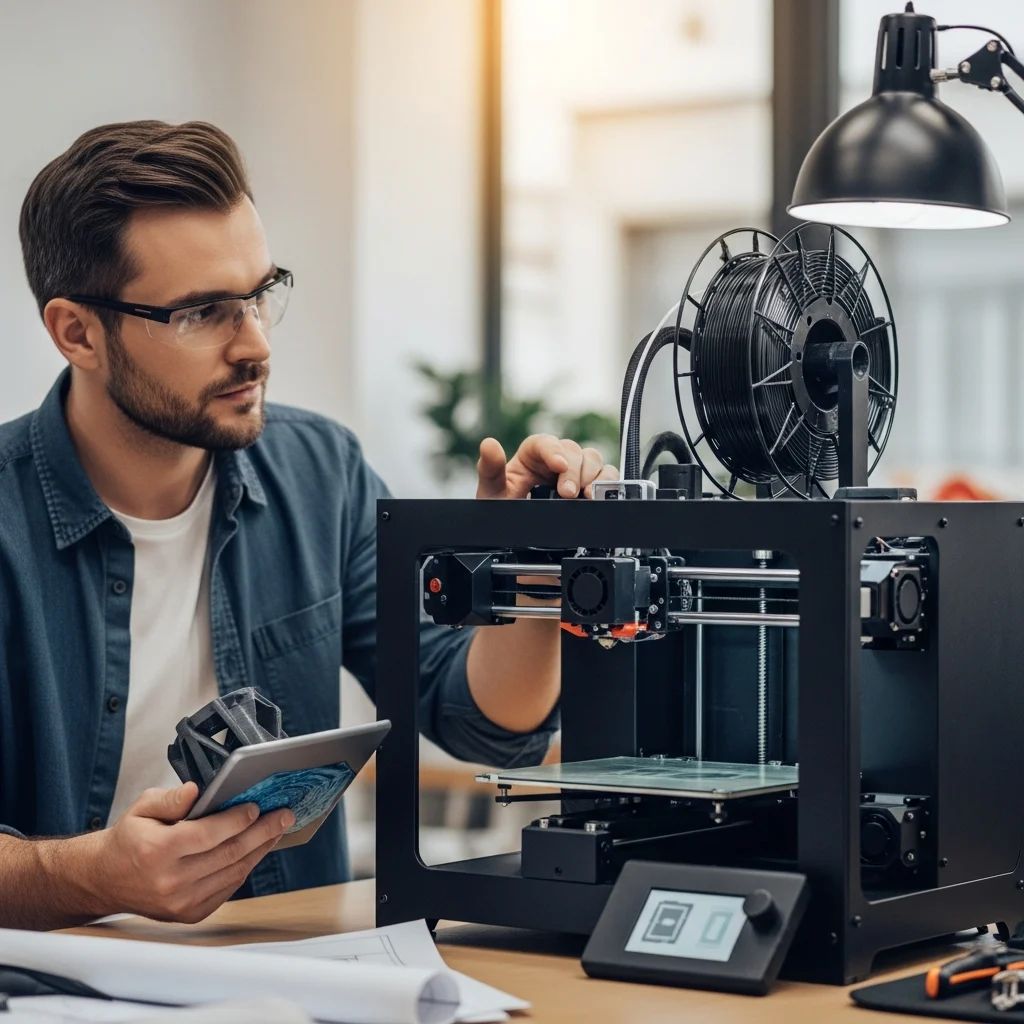
For decades, traditional manufacturing relied heavily on subtractive processes—cutting, drilling, or milling material away from a solid block to achieve a desired shape. Today, a paradigm shift is underway. 3D printing technology has evolved from a niche prototyping tool into a foundational pillar of modern manufacturing, enabling engineers and creators to build highly complex geometries that were previously impossible to produce.
Direct Answer: 3D printing technology, also known as additive manufacturing, is a process of creating three-dimensional solid objects from a digital file. It works by laying down successive layers of material—such as plastics, resins, or metals—until the final object is fully formed. This technology is widely used across industries for rapid prototyping, manufacturing complex geometries, and creating custom medical implants.
The Core Mechanics of Additive Manufacturing
Process of additive manufacturing and 3D printing stages outline diagram
At its core, additive manufacturing operates on a simple principle: building an object one micro-layer at a time. Unlike traditional machining, which removes material and creates significant waste, 3D printing only deposits material exactly where it is needed. This fundamentally changes the economics of manufacturing, particularly for low-volume, highly complex parts. The process always begins with a digital 3D model, but the physical execution varies significantly depending on the specific hardware being used.
Fused Deposition Modeling (FDM) vs. Stereolithography (SLA)
The two most accessible and widely utilized forms of 3D printing are Fused Deposition Modeling (FDM) and Stereolithography (SLA).
FDM is the standard technology used by most desktop 3D printers. It works by feeding a spool of thermoplastic filament (such as PLA, ABS, or PETG) into a heated extrusion head. The printer melts the plastic and precisely deposits it along a programmed X and Y axis, moving up the Z axis layer by layer. It is highly cost-effective and excellent for functional mechanical parts.
SLA, on the other hand, relies on photopolymerization. Instead of melting plastic, an SLA printer uses a vat of liquid photopolymer resin. A targeted ultraviolet (UV) laser or light projector cures the resin layer by layer, hardening it into a solid shape. SLA is renowned for producing exceptionally high-resolution prints with smooth surface finishes, making it the preferred choice for jewelry casting, dental models, and highly detailed miniatures.
The Role of CAD and Slicing Software
No 3D printer can operate without a set of digital instructions. The workflow begins with Computer-Aided Design (CAD) software, where engineers draft the precise dimensions of the object. Once the 3D model is complete, it is exported (typically as an STL or OBJ file) into a specialized program called a “slicer.”
The slicer translates the 3D model into thousands of horizontal layers and generates G-code—the programming language that tells the printer’s motors exactly where to move, how fast to extrude, and what temperature to maintain. Processing complex CAD models and running advanced slicing algorithms requires significant computational power. If you are experiencing software crashes or lag during the slicing process, it might be necessary to wipe your laptop clean to eliminate bloatware and restore peak workstation performance before rendering heavy files.
Builder’s Insight: When preparing a CAD model for printing, adjusting the internal infill pattern is just as crucial as your external material choice. For load-bearing mechanical parts, utilizing a “gyroid” infill pattern rather than a standard grid provides superior multi-directional strength while simultaneously reducing overall material usage and print time.
Key Industrial and Consumer Applications
As printing hardware has become faster and materials more robust, additive manufacturing has firmly entrenched itself in critical global industries.
Healthcare and Custom Bioprinting
The medical sector has been revolutionized by the ability to print custom, patient-specific devices. Audiologists routinely use SLA printing to create custom-fit hearing aids, while orthopedic surgeons rely on 3D-printed titanium implants that match a patient’s bone structure perfectly. Furthermore, the emerging field of bioprinting aims to use specialized bio-inks containing living cells to print functional tissue, paving the way for future organ generation and advanced drug testing.
Aerospace and Automotive Engineering
In aerospace and automotive manufacturing, weight reduction directly translates to fuel efficiency and performance. 3D printing allows engineers to utilize “generative design”—software algorithms that optimize a part’s geometry to be as lightweight as possible while retaining maximum structural integrity. Engineers can consolidate assemblies that traditionally required dozens of separate milled parts into a single, complex 3D-printed metal component, drastically simplifying the supply chain.
The Future of 3D Printing: AI and Advanced Materials
The next frontier of 3D printing lies in the convergence of advanced composite materials and artificial intelligence. We are seeing a surge in printers capable of continuously weaving carbon fiber or printing with high-performance aerospace polymers like PEEK.
Simultaneously, software intelligence is transforming print reliability. The industry focus is rapidly shifting toward building agentic AI apps capable of monitoring active print jobs through computer vision. These AI agents can detect microscopic layer shifts or extrusion anomalies in real-time, automatically adjusting print parameters to prevent catastrophic failures before they happen, saving massive amounts of time and industrial material.
Frequently Asked Questions (FAQs)
What materials can be used in 3D printing?
Modern 3D printing can utilize a vast array of materials. Common choices include thermoplastics (PLA, ABS, Nylon), photopolymer resins, metals (titanium, aluminum, stainless steel), ceramics, carbon fiber composites, and even edible materials like chocolate or specialized bio-inks for medical tissue engineering.
Is 3D printing cost-effective for mass production?
For low-to-medium volume production and highly customized parts, 3D printing is exceptionally cost-effective because it eliminates the need for expensive tooling and molds. However, for producing millions of identical plastic parts, traditional methods like injection molding remain significantly faster and cheaper per unit.
How long does it take to 3D print an average object?
The printing time depends entirely on the size, complexity, layer height, and the specific technology used. A small, simple trinket on an FDM printer might take 30 to 45 minutes, while a large, high-resolution industrial part or a complex metal print can take anywhere from 24 hours to several days to complete.
Conclusion
3D printing technology is no longer just an experimental concept; it is a critical driver of modern industrial innovation. By decentralizing manufacturing, enabling rapid iteration, and allowing for the creation of incredibly complex geometries, additive manufacturing continues to push the boundaries of what engineers, medical professionals, and everyday creators can achieve. As AI integration and material science continue to advance, the scope of what we can print will only continue to expand.