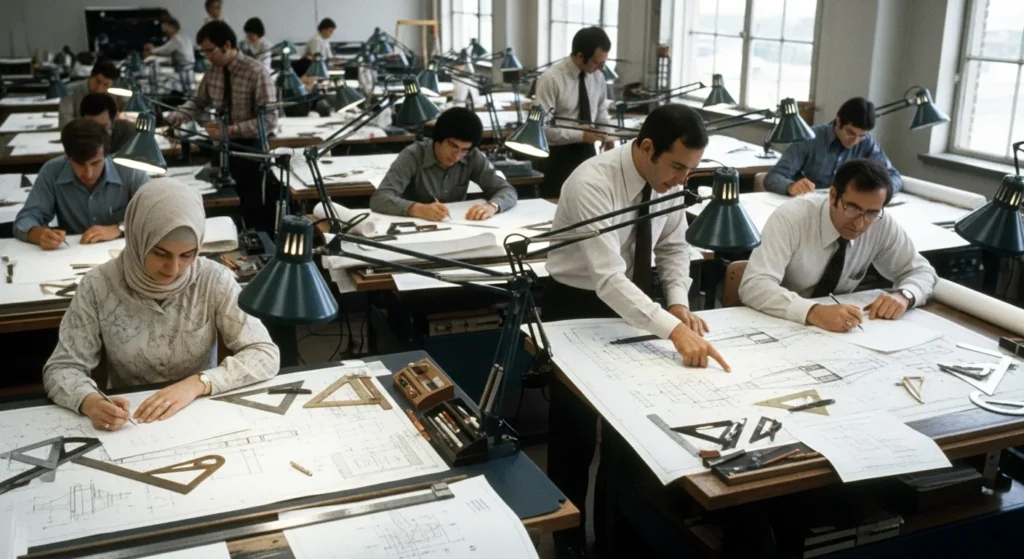
In the modern era of cloud-based CAD and AI-driven simulations, it is difficult to fathom the sheer physical scale of mid-century aerospace engineering. Long before the first line of code was written for a flight control system, the giants of the sky were born on paper. The boeing drafting room was not just an office; it was a sprawling, humming engine of human calculation that stretched across acres of floor space.
Walking into a 1960s drafting room at Boeing was an assault on the senses. The air was thick with the scent of graphite, vellum, and cigarette smoke. Thousands of men in white short-sleeved shirts and narrow ties leaned over massive wooden tables, their movements synchronized in a quiet, intense ballet of precision. This was the birthplace of the 747, the ‘Queen of the Skies,’ and every bolt, rib, and rivet was hand-drawn with agonizing detail.
The Immense Scale of the 1960s Drafting Room at Boeing
The 1960s drafting room boeing utilized was a marvel of industrial organization. Because there were no digital databases, the physical layout of the room mirrored the hierarchy of the aircraft itself. Sections of the floor were dedicated to specific systems: one area for the wing assembly, another for the fuselage, and another for the complex hydraulic systems. If a designer working on the landing gear needed to check a clearance issue with the wing spar, he didn’t send an email; he walked several hundred yards across the room to consult the master drawing.
This physical proximity was essential. Coordination was managed through a rigorous system of ‘checkers’—senior engineers whose entire job was to verify the work of others. A single mistake on a drawing could lead to thousands of dollars in wasted aluminum and months of delays. In an era where lucrative careers in the technical sector were defined by manual mastery, these men were the elite.
Tools of the Trade: Precision Without Pixels
The primary tools of the Boeing drafting room were deceptively simple but required years of practice to master. Engineers relied on:
- The Slide Rule: The precursor to the calculator, used for every complex aerodynamic calculation.
- T-Squares and Triangles: Essential for maintaining perfectly parallel and perpendicular lines across drawings that could be several feet long.
- Vellum and Mylar: The durable, translucent surfaces upon which the future of aviation was inked.
- Electric Erasers: A prized possession for any drafter, allowing for clean corrections on delicate surfaces.
The level of concentration required was immense. A drafter might spend weeks on a single detailed view of a wing flap mechanism. If he spilled coffee or smudged the ink, he might have to start the entire sheet from scratch. This high-stakes environment fostered a unique culture of discipline and camaraderie among the engineering staff.
Project Management in the Pre-Digital Era
How did Boeing manage tens of thousands of individual drawings without a centralized server? The answer lay in a massive physical archive and a strict version-control protocol. When a drawing was completed, it was photographed and turned into ‘blueprints’ or ‘aperture cards’—small pieces of microfilm mounted on punch cards. These were then distributed to the factory floor.
Today, firms use modern software for architecture and engineering to track changes in real-time. In 1966, ‘real-time’ meant a messenger boy running a revised drawing from the engineering building to the assembly line. Despite the lack of instant communication, the 747 went from a concept to its first flight in just 28 months—a feat of project management that remains legendary in the aerospace industry.
The Legacy of the Manual Drafting Era
By the late 1970s and early 1980s, the sun began to set on the traditional drafting room. The introduction of CATIA (Computer-Aided Three-Dimensional Interactive Application) changed everything. The massive rows of tables were slowly replaced by glowing green CRT monitors. The tactile connection between the engineer’s hand and the paper was severed, replaced by the click of a mouse.
While efficiency skyrocketed, many veterans of the original Boeing drafting rooms look back on that era with nostalgia. There was a holistic understanding of the machine that came from drawing every curve by hand. When you spend ten hours drawing a single bulkhead, you understand its stresses and its purpose in a way that a digital model can struggle to replicate.
Frequently Asked Questions
How many engineers worked in the Boeing drafting rooms?
At the height of the 747 program in the late 1960s, Boeing employed over 50,000 people in its engineering and technical divisions, with thousands of drafters working simultaneously in massive open-plan offices.
What replaced the traditional drafting tables at Boeing?
Traditional tables were replaced by Computer-Aided Design (CAD) workstations. Boeing was a pioneer in adopting digital modeling, eventually using the 777 as the first commercial aircraft to be designed entirely on a computer.
Was the 747 really designed entirely by hand?
Yes. The initial design, wind tunnel testing, and detailed engineering drawings for the original Boeing 747-100 were all performed using manual drafting techniques and slide rule calculations.
How did they fix mistakes on the drawings?
Small errors were corrected using electric erasers and specialized scraping tools to remove ink from vellum. Major changes often required redrawing the entire section to ensure structural integrity and clarity for the manufacturing teams.