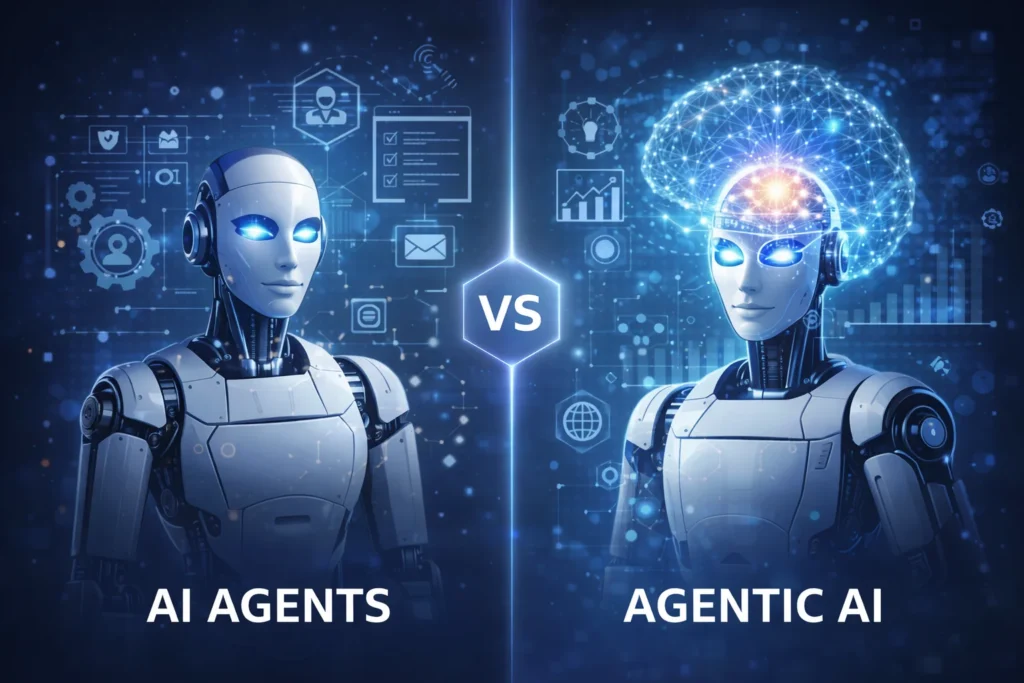
In the rapidly evolving world of artificial intelligence, terms like “AI agents” and “agentic AI” are often used interchangeably, but they represent distinct concepts with unique implications for technology and society. As businesses and developers explore these technologies, understanding their differences is crucial for effective implementation and innovation. This guide breaks down the key distinctions, helping you navigate the landscape of autonomous systems and intelligent frameworks.
⚡ Quick Answer
AI agents are individual autonomous systems that perform specific tasks, while agentic AI refers to broader frameworks or ecosystems where multiple AI agents collaborate or operate with enhanced autonomy. Think of AI agents as the “workers” and agentic AI as the “workplace” or “strategy” enabling their coordination and advanced capabilities.
What Are AI Agents?
AI agents are software entities designed to perceive their environment, make decisions, and take actions to achieve specific goals autonomously. They operate without constant human intervention, using algorithms and data to adapt and respond to changing conditions. Common examples include chatbots, recommendation systems, and autonomous vehicles. These agents are often task-specific, focusing on narrow domains like customer service or data analysis. For insights into developing such systems, check out our guide on building agentic AI apps with a problem-first approach.
- Autonomous Operation: AI agents can function independently once deployed.
- Goal-Oriented: They are designed to achieve predefined objectives.
- Adaptive Learning: Many agents use machine learning to improve over time.
- Task-Specific Focus: They excel in narrow applications like filtering spam or optimizing routes.
What Is Agentic AI?
Agentic AI refers to systems or frameworks where AI agents exhibit higher levels of autonomy, collaboration, and decision-making capabilities. It encompasses the principles, architectures, and technologies that enable agents to operate in more complex, dynamic environments. Unlike individual AI agents, agentic AI often involves multi-agent systems, ethical governance, and scalable infrastructures. This concept is gaining traction as industries seek more integrated and intelligent solutions. To ensure these systems are secure, refer to our cloud security checklist for best practices.
- Collaborative Ecosystems: Multiple agents work together to solve problems.
- Enhanced Autonomy: Agents make more independent decisions with less oversight.
- Ethical Frameworks: Includes guidelines for responsible AI use.
- Scalable Architectures: Designed to handle growing complexity and data volumes.
Key Differences Between AI Agents and Agentic AI
Understanding the distinctions between AI agents and agentic AI is essential for leveraging their full potential. The table below summarizes the core differences based on scope, functionality, and application.
| Aspect | AI Agents | Agentic AI |
|---|---|---|
| Scope | Individual entities | Systems or frameworks |
| Autonomy Level | Moderate (task-specific) | High (strategic decision-making) |
| Collaboration | Limited or none | Extensive (multi-agent coordination) |
| Examples | Chatbots, drones | Smart cities, enterprise AI platforms |
| Primary Focus | Executing specific tasks | Enabling autonomous ecosystems |
AI agents are like specialized tools—efficient for particular jobs but limited in broader contexts. In contrast, agentic AI represents the infrastructure that allows these tools to interact, learn, and evolve together. For businesses, this means agentic AI can drive innovation at scale, while AI agents handle day-to-day operations. Explore our about us page to learn how we cover such tech trends.
Applications and Use Cases
Both AI agents and agentic AI have diverse applications across industries. AI agents are commonly used in customer service, healthcare diagnostics, and financial trading, where they automate repetitive tasks. Agentic AI, however, shines in complex scenarios like supply chain management, smart grid optimization, and collaborative robotics. For instance, in fintech, AI agents might analyze transaction data, while agentic AI could oversee entire financial ecosystems. Discover more in our review of top fintech apps for 2026.
- AI Agents in Healthcare: Monitor patient vitals and alert staff to anomalies.
- Agentic AI in Manufacturing: Coordinate robots and IoT devices for efficient production lines.
- AI Agents in E-commerce: Personalize product recommendations based on user behavior.
- Agentic AI in Transportation: Manage traffic flow and autonomous vehicle networks in smart cities.
Future Trends and Implications
The evolution of AI agents and agentic AI is poised to reshape technology and society. As AI agents become more sophisticated, they’ll handle increasingly complex tasks, reducing human workload. Agentic AI will drive the development of autonomous systems that can self-organize and adapt to unforeseen challenges. Ethical considerations, such as bias mitigation and transparency, will be critical, especially as these technologies integrate into critical infrastructure. Staying informed through resources like our privacy policy can help navigate these changes responsibly.
- Increased Integration: More seamless blending of AI agents into daily life and business processes.
- Regulatory Developments: New laws and standards for autonomous AI systems.
- Advancements in Collaboration: Improved multi-agent communication and problem-solving.
- Focus on Sustainability: Using agentic AI to address environmental and social challenges.
FAQs: People Also Ask
What is the main difference between AI agents and agentic AI?
AI agents are individual autonomous systems focused on specific tasks, while agentic AI refers to broader frameworks or ecosystems that enable enhanced autonomy, collaboration, and decision-making among multiple agents.
Can AI agents work without agentic AI?
Yes, AI agents can operate independently as standalone systems, such as simple chatbots or recommendation engines. However, agentic AI enhances their capabilities by enabling coordination and more complex behaviors in multi-agent environments.
How do businesses benefit from agentic AI?
Businesses benefit from agentic AI through improved efficiency, scalability, and innovation. It allows for the integration of multiple AI agents to handle complex processes, adapt to dynamic markets, and drive strategic decision-making with minimal human intervention.
Are there risks associated with agentic AI?
Yes, risks include ethical concerns like bias, lack of transparency, and potential job displacement. Security vulnerabilities and over-reliance on autonomous systems are also challenges that require careful management and regulatory oversight.
What industries use AI agents the most?
Industries like healthcare, finance, e-commerce, and customer service heavily use AI agents for tasks such as diagnostics, trading, personalization, and support. Their task-specific nature makes them ideal for automating routine operations in these sectors.
How can I learn more about developing AI agents?
Start by exploring online courses, academic resources, and practical guides. For hands-on insights, read our article on building agentic AI apps, which covers development strategies and best practices.
Is agentic AI the same as artificial general intelligence (AGI)?
No, agentic AI focuses on autonomous systems and frameworks within specific domains, while AGI refers to hypothetical AI with human-like general intelligence across all tasks. Agentic AI is a step toward more advanced AI but not equivalent to AGI.
What tools are essential for implementing agentic AI?
Essential tools include cloud platforms for scalability, machine learning frameworks like TensorFlow, collaboration software for multi-agent systems, and security tools to protect data. Refer to our cloud security checklist for guidance on safe implementation.