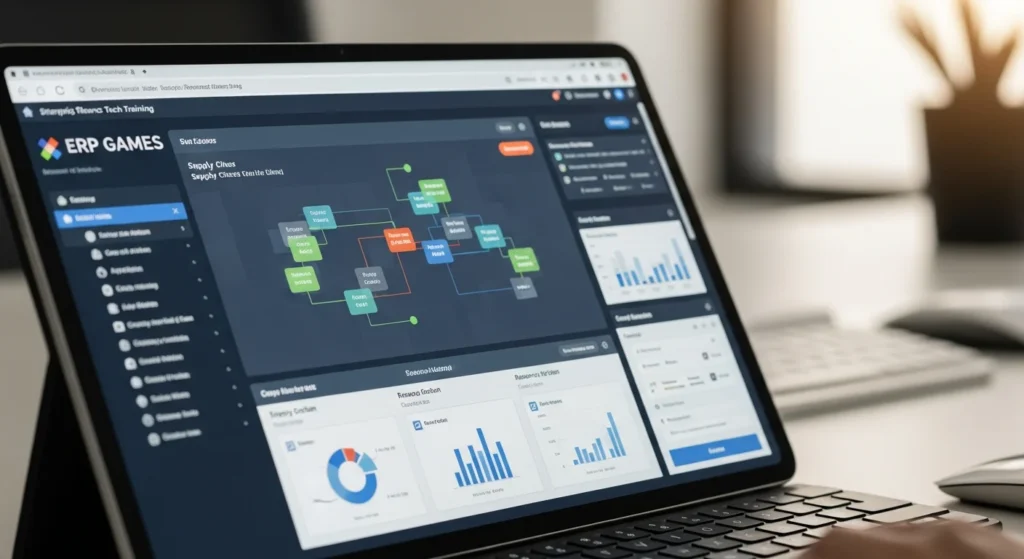
In today’s fast-paced business environment, enterprise resource planning (ERP) systems are crucial for operational efficiency, but training employees on these complex platforms can be challenging. Enter ERP games—an innovative approach that transforms traditional enterprise tech training into engaging, interactive experiences. By leveraging gamification principles, these tools make learning ERP systems more effective and enjoyable, addressing common pain points like low engagement and knowledge retention. This comprehensive guide explores everything you need to know about ERP games, from their core concepts to practical applications in modern business settings.
ERP games are gamified training tools that use interactive simulations, quizzes, and challenges to teach employees how to use enterprise resource planning systems effectively. They enhance engagement, improve knowledge retention, and reduce training costs by making complex enterprise tech learning fun and practical.
Understanding ERP Games: The Basics
ERP games are specialized training solutions designed to educate users on ERP software through game-like elements. Unlike conventional training methods, which often involve lengthy manuals or passive lectures, ERP games incorporate points, levels, badges, and real-world scenarios to create an immersive learning environment. This approach is particularly valuable in enterprise tech, where systems like SAP, Oracle, and Microsoft Dynamics require detailed understanding for optimal use. By simulating actual business processes—such as inventory management, financial reporting, or supply chain operations—these games help employees grasp complex concepts without the risk of real-world errors.
Key Benefits of ERP Games in Enterprise Tech
Implementing ERP games offers numerous advantages for organizations looking to enhance their enterprise tech training programs. Here are some of the most significant benefits:
- Increased Engagement: Gamification taps into natural human competitiveness and curiosity, making training sessions more interactive and less monotonous.
- Improved Knowledge Retention: Studies show that gamified learning can boost retention rates by up to 40% compared to traditional methods, as users actively participate rather than passively absorb information.
- Cost-Effectiveness: By reducing the need for in-person trainers and minimizing errors during live system use, ERP games can lower overall training expenses.
- Scalability: These tools can be deployed across large organizations, ensuring consistent training quality regardless of employee location or department.
- Real-Time Feedback: Instant scoring and progress tracking allow learners to identify areas for improvement immediately, accelerating the mastery of enterprise tech skills.
For businesses exploring other enterprise tech solutions, understanding tools like Oracle ERP Cloud managed services can complement gamified training by providing robust platform support.
Types of ERP Games and How They Work
ERP games come in various formats, each tailored to different learning objectives and enterprise tech environments. Below is a table comparing common types:
| Type | Description | Best For |
|---|---|---|
| Simulation Games | Replicate real ERP tasks, such as processing invoices or managing orders, in a risk-free virtual setting. | Hands-on practice for new users |
| Quiz-Based Games | Use multiple-choice questions or puzzles to test knowledge on ERP modules like finance or HR. | Reinforcing theoretical concepts |
| Scenario Challenges | Present business problems that require ERP solutions, encouraging critical thinking and system navigation. | Advanced training for experienced staff |
| Multiplayer Competitions | Allow teams to compete in ERP tasks, fostering collaboration and peer learning. | Building departmental cohesion |
These games often integrate with existing ERP platforms, providing a seamless learning experience that mirrors actual workflows. For instance, a simulation might guide users through generating financial reports in SAP, while a quiz could cover compliance rules within the system. By aligning with specific enterprise tech needs, such as those addressed in SaaS Grund problems solved, ERP games ensure relevance and practicality.
Implementing ERP Games: A Step-by-Step Guide
Successfully deploying ERP games requires careful planning and alignment with organizational goals. Follow these steps to integrate gamified training into your enterprise tech strategy:
- Assess Training Needs: Identify which ERP modules or processes employees struggle with most, such as inventory management or financial closing.
- Choose the Right Game Type: Select simulations, quizzes, or challenges based on your learning objectives—for example, use scenario games for problem-solving skills.
- Customize Content: Tailor game scenarios to reflect your company’s specific ERP configurations and business rules, ensuring realism.
- Integrate with Existing Systems: Ensure the games work smoothly with your ERP software, possibly leveraging APIs or plugins for seamless data flow.
- Launch and Monitor: Roll out the games to targeted user groups, track participation rates and scores, and gather feedback for improvements.
- Measure ROI: Evaluate metrics like reduced training time, fewer system errors, and increased user proficiency to justify the investment.
This approach mirrors best practices in other enterprise tech areas, such as those highlighted in SaaS lifecycle management problems solved, where systematic implementation is key to success.
Common Challenges and Solutions
While ERP games offer significant benefits, organizations may face obstacles during adoption. Here are some common issues and how to address them:
- Resistance to Change: Employees accustomed to traditional training might be skeptical of gamified methods. Solution: Start with pilot programs and highlight success stories to build buy-in.
- Technical Integration Hurdles: Connecting games to legacy ERP systems can be complex. Solution: Work with vendors who offer customizable solutions or consult experts in enterprise tech integration.
- Content Relevance: Generic games may not align with specific business processes. Solution: Invest in tailored content development or use platforms that allow easy customization.
- Measuring Effectiveness: It can be tricky to quantify the impact on performance. Solution: Use analytics dashboards within the games to track progress and correlate with operational metrics.
Overcoming these challenges often requires a holistic view of enterprise tech, similar to strategies used in CRM for VC business analysis, where alignment with business goals is crucial.
The Future of ERP Games in Enterprise Tech
As technology evolves, ERP games are poised to become even more sophisticated and integral to corporate training. Trends like artificial intelligence (AI) and virtual reality (VR) are set to enhance these tools, offering personalized learning paths and immersive simulations. For example, AI could adapt game difficulty based on user performance, while VR might create 3D environments for practicing ERP tasks. Additionally, the rise of remote work is driving demand for cloud-based gamified training that employees can access from anywhere. These advancements will further bridge the gap between theoretical knowledge and practical application in enterprise tech, making systems like ERP more accessible and efficient to use.
Looking ahead, the integration of ERP games with other innovative technologies, such as those explored in agentic AI orchestration, could revolutionize how businesses train their workforce, leading to smarter, more agile organizations.
Frequently Asked Questions (FAQ)
What are ERP games used for?
ERP games are used to train employees on enterprise resource planning systems through interactive, game-like experiences. They help users learn complex ERP functionalities—such as data entry, reporting, and process management—in an engaging way that improves retention and reduces training costs.
How do ERP games improve enterprise tech training?
ERP games improve training by increasing engagement through gamification elements like points and badges, providing hands-on practice in risk-free simulations, and offering real-time feedback. This leads to better knowledge retention, faster skill acquisition, and higher proficiency in using ERP systems.
Are ERP games suitable for all types of businesses?
Yes, ERP games can be adapted for businesses of all sizes and industries, from small startups to large corporations. They are particularly beneficial for organizations with complex ERP implementations or those undergoing digital transformations, as they simplify learning and boost adoption rates.
What is the cost of implementing ERP games?
The cost varies based on factors like game complexity, customization needs, and integration requirements. Options range from off-the-shelf solutions for a few hundred dollars to fully customized platforms costing thousands. However, the long-term savings from reduced training time and errors often justify the investment.
Can ERP games be integrated with existing ERP software?
Yes, most ERP games are designed to integrate with popular ERP systems like SAP, Oracle, or Microsoft Dynamics through APIs or plugins. This ensures that training scenarios reflect actual workflows and data, making the learning experience more relevant and effective.
How do you measure the success of ERP games?
Success can be measured using metrics such as user engagement rates, completion times, quiz scores, and post-training performance indicators (e.g., reduced error rates in live ERP use). Surveys and feedback from participants also provide qualitative insights into effectiveness.
What are the latest trends in ERP games?
Current trends include the use of AI for personalized learning, VR for immersive simulations, and mobile-friendly designs for on-the-go training. There’s also a growing focus on social features, like leaderboards and team challenges, to foster collaboration in enterprise tech environments.
Where can I find ERP game providers?
ERP game providers can be found through enterprise tech vendors, specialized training companies, or online marketplaces. It’s important to evaluate options based on your specific ERP system, budget, and training goals to ensure a good fit.