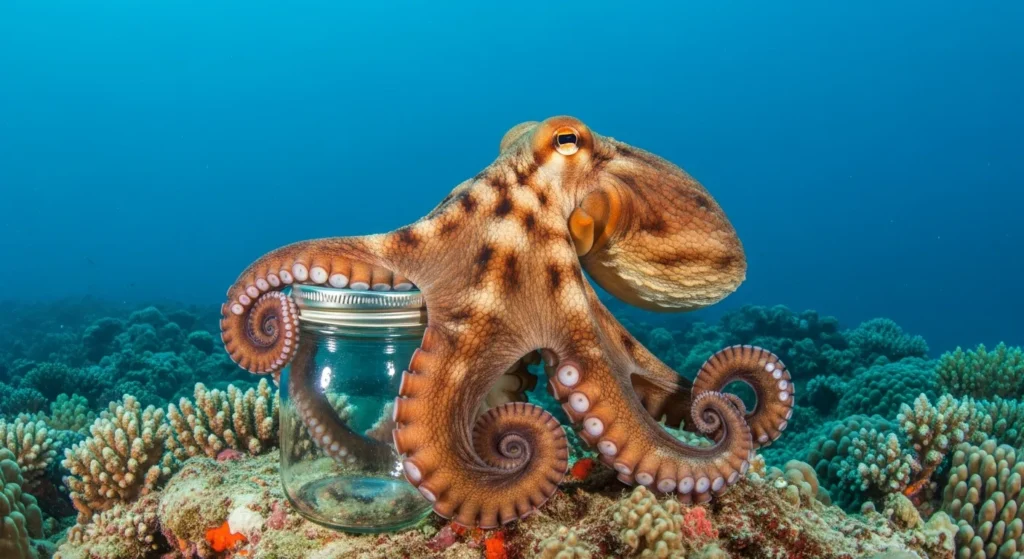
The Alien Intelligence of the Deep
For decades, marine biologists and animal behaviorists have been captivated by the octopus. Unlike most intelligent species on Earth, which are vertebrates like mammals and birds, the octopus belongs to the class Cephalopoda. This means their intelligence evolved on a completely different evolutionary track. When a researcher observes an octopus in his laboratory, he isn’t just looking at a clever fish; he is looking at a creature with a distributed nervous system that functions more like a network than a centralized command center.
As of 2026, new neurological mapping has revealed even more about how these creatures process information. While many people wonder if squirrels are smart because of their complex nut-hiding tactics, the octopus operates on a level of cognitive complexity that rivals some primates. Their ability to solve puzzles, use tools, and even display distinct personalities has fundamentally changed our understanding of what it means to be ‘smart.’
A Brain Without a Body: The Distributed Nervous System
The most striking aspect of octopus intelligence is its structure. An octopus has roughly 500 million neurons, which is comparable to a dog. However, the way these neurons are organized is unique. Only about one-third of an octopus’s neurons are located in its central brain. The remaining two-thirds are found in its arms.
- Autonomous Arms: Each arm can essentially ‘think’ for itself. If an octopus is busy exploring a crevice with one arm, his other arms can be hunting for food or navigating the terrain independently.
- Sensory Processing: The suckers on an octopus’s arms are packed with chemoreceptors. This allows him to taste and touch everything he encounters, processing that data locally before sending only the most relevant information to the central brain.
- Rapid Reaction: This decentralized structure allows for incredibly fast reactions, which is vital for a soft-bodied animal living in a world of sharp-toothed predators.
Problem-Solving and Tool Use
One of the hallmarks of high intelligence is the ability to use tools—a trait once thought to be exclusive to humans. Octopuses have debunked this myth repeatedly. In the wild, the Veined Octopus has been observed carrying coconut shell halves across the ocean floor. When he feels threatened, he assembles the shells into a protective fortress, hiding inside until the danger passes.
In laboratory settings, the octopus continues to impress. When a scientist presents him with a jar containing a delicious crab, the octopus doesn’t just pull at the lid. He uses his suckers to apply torque, unscrewing the jar with precision. This level of manipulation and understanding of mechanics is rare in the animal kingdom. Researchers have noted that when a scientist observes an octopus in his laboratory, the creature often displays a level of recognition and curiosity similar to what one might see when studying how smart Australian Shepherds are in a domestic setting.
The Mastery of Camouflage
Octopus intelligence isn’t just about solving puzzles; it is also about survival through deception. The octopus possesses specialized cells called chromatophores, which allow him to change his skin color and texture in milliseconds. This is not a simple reflex; it is a cognitive process.
An octopus must analyze his surroundings, determine which patterns will best hide him from a predator, and then manipulate his skin to match. Some species, like the Mimic Octopus, take this a step further. He can impersonate other toxic sea creatures, such as sea snakes or lionfish, by changing his shape and movement patterns. This requires a sophisticated mental map of his environment and the creatures within it.
Do Octopuses Have Personalities?
Anyone who has spent significant time with these animals will tell you that they are individuals. In aquarium settings, an octopus may develop a preference for a specific caretaker while showing disdain for another. He might spray water at a person he dislikes or approach a person he trusts for interaction. This suggests a level of emotional intelligence and long-term memory that is quite advanced for an invertebrate.
Frequently Asked Questions
How smart are octopuses compared to humans?
While they don’t have human-like logic or language, their problem-solving skills and ability to manipulate their environment are comparable to those of a young child or a highly intelligent mammal like a dolphin or a dog.
Can an octopus recognize a person?
Yes. Studies have shown that an octopus can distinguish between different humans, even when they are wearing the same clothing. He will react differently based on his past experiences with that specific individual.
Do octopuses feel pain?
Most scientists agree that octopuses are sentient and capable of feeling both physical pain and psychological stress. This has led to increased protections for them in laboratory research settings as of 2026.
How long do octopuses live?
Unfortunately, despite their high intelligence, most octopuses have short lifespans, typically ranging from one to five years depending on the species. They usually die shortly after mating and brooding their eggs.