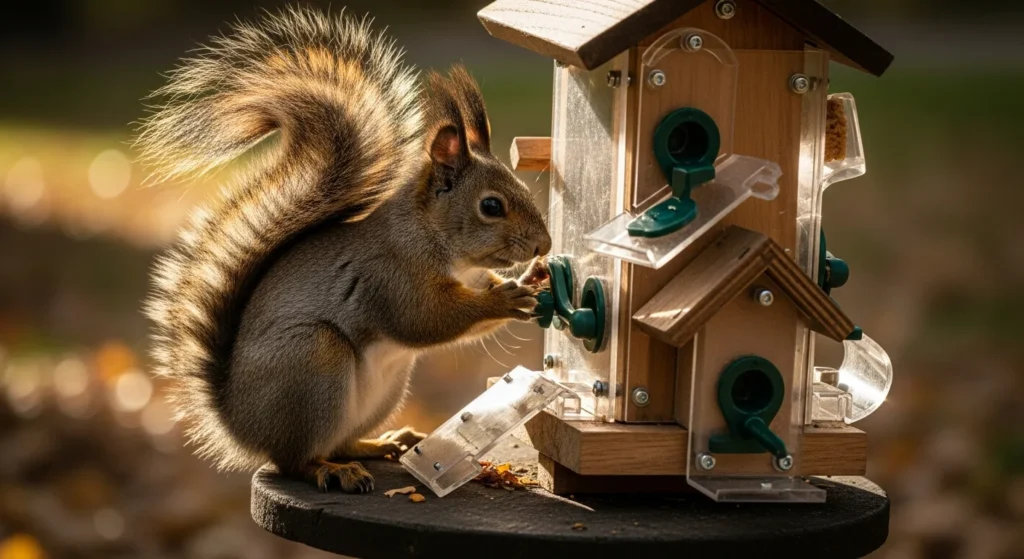
We see them every day, darting across power lines and performing death-defying leaps from branch to branch. To the casual observer, a squirrel might seem like a simple, frantic creature driven purely by instinct. However, if you have ever watched one systematically dismantle a “squirrel-proof” bird feeder, you have witnessed a level of problem-solving that rivals some of the most intelligent species on the planet.
So, are squirrels smart? The short answer is a resounding yes. These rodents possess a sophisticated cognitive toolkit that includes advanced spatial memory, social deception, and the ability to learn through observation. In this article, we will dive deep into the science of squirrel intelligence and see how they stack up against the animal kingdom’s heavyweights.
Spatial Memory: The Master of the Cache
One of the most impressive feats of squirrel intelligence is their memory. A single gray squirrel can bury several thousand nuts in a single season. Contrary to the myth that they simply stumble upon their stashes by smell, research has shown that squirrels use a complex internal map to relocate their food.
Scientists have discovered that squirrels utilize a technique called spatial chunking. They categorize their nuts by species, quality, and even preference, burying them in specific areas that act as a mental filing cabinet. This organized approach to storage allows them to recover up to 80% of their hidden caches, even months later under a blanket of snow.
Tactical Deception: The Art of the Fake-Out
Squirrel intelligence isn’t just about finding food; it is also about protecting it. Squirrels are known to engage in tactical deception. If a squirrel suspects it is being watched by a potential thief—whether another squirrel or a bird—it will perform a “sham burying” maneuver.
The squirrel will dig a hole, pretend to drop a nut inside, and cover it up with leaves, all while keeping the actual nut hidden in its mouth. It then scurries off to a more private location to bury the real prize. This level of social awareness suggests a high degree of cognitive complexity, often referred to as a “theory of mind,” where an animal understands the intent of others.
Problem-Solving and Urban Adaptation
The urban environment is a constant IQ test for wildlife. Squirrels have proven exceptionally adept at navigating human-made obstacles. Their ability to solve multi-step puzzles to reach food is well-documented in laboratory settings and backyards alike. While we often associate high intelligence with marine life, such as when we ask are octopus smart, the cognitive feats of land-dwelling rodents in navigating complex 3D environments are equally impressive.
Squirrels are also capable of observational learning. They can watch a peer tackle a difficult obstacle, such as a complex bird feeder mechanism, and mimic the successful behavior to achieve the same result. This ability to learn from the successes and failures of others is a hallmark of high-level intelligence.
How Squirrel Intelligence Compares
When we evaluate animal intelligence, we often look at adaptability and brain-to-body ratio. Squirrels have remarkably large brains for their size, particularly the areas associated with vision and motor skills. Comparing a squirrel’s problem-solving to domesticated breeds, such as questioning are australian shepherds smart, reveals that while dogs excel in social cues and human communication, squirrels are masters of independent spatial reasoning and environmental manipulation.
Summary of Squirrel Cognitive Traits
- Advanced Memory: The use of spatial chunking to manage thousands of hidden food sources.
- Critical Thinking: The ability to navigate complex physical obstacles and “squirrel-proof” barriers.
- Deceptive Tactics: Using fake caches to mislead competitors and protect resources.
- Rapid Learning: Adapting to new environments and learning through observation.
Ultimately, the intelligence of a squirrel is a specialized form of brilliance. They are built for survival in a high-stakes, three-dimensional world where memory and quick thinking are the difference between life and death. The next time you see one in your yard, remember: you aren’t just looking at a rodent; you’re looking at one of nature’s most capable engineers.
Frequently Asked Questions
Do squirrels remember where they hide every nut?
While they don’t remember every single one, they use spatial memory and “chunking” to relocate the vast majority of their caches. They rely on landmarks like trees and buildings to create a mental map.
Can squirrels recognize individual humans?
Yes, anecdotal evidence and some studies suggest that squirrels can recognize humans who regularly provide food, often showing less fear and even approaching those specific individuals.
Are squirrels smarter than rats?
Both are highly intelligent, but they excel in different areas. Rats are often better at social tasks and navigating mazes in a lab, while squirrels show superior spatial memory and physical problem-solving in the wild.