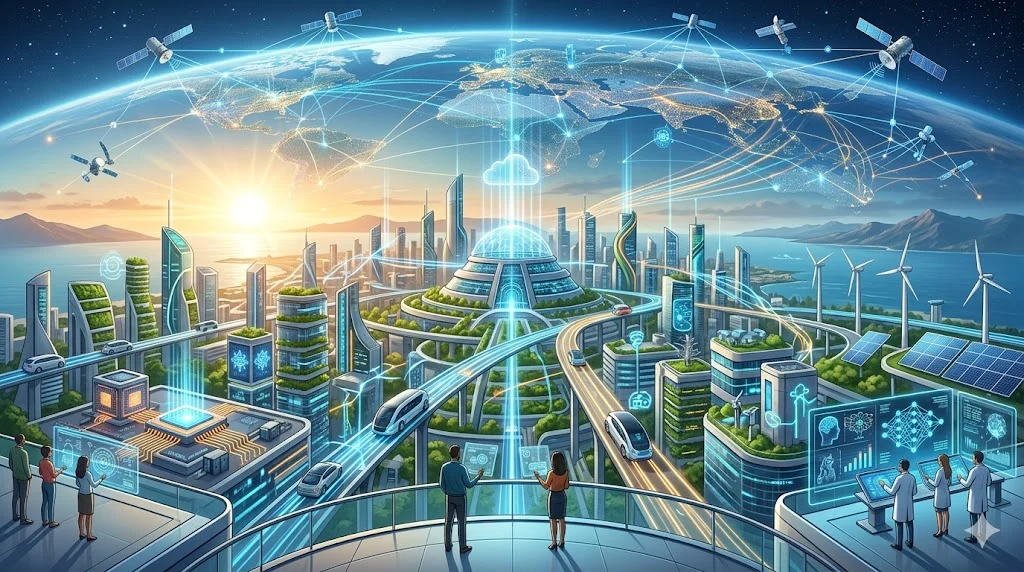
As we navigate through 2026, the digital landscape has shifted from simple digital transformation to a more holistic concept: the ability to togtechify our lives and businesses. This term represents the seamless, intelligent integration of hardware and software into every facet of human endeavor. No longer is technology a separate tool; it is the very fabric of our operational reality.
For the modern professional or tech enthusiast, staying ahead of these shifts is not just about knowing the latest gadgets. It is about understanding the deep architectural changes in how data is processed, how security is maintained, and how artificial intelligence has evolved into an autonomous partner.
1. The Evolution of Agentic AI and Autonomous Workflows
The most significant trend in 2026 is the transition from passive AI to Agentic AI. In previous years, users had to prompt AI to get a result. Today, the major trends in technology togtechify the workplace by deploying agents that can reason, plan, and execute multi-step tasks without constant human intervention.
These agents are now capable of managing entire supply chains or complex software development lifecycles. For instance, when a developer is building a new platform, understanding the ai agents vs agentic ai differences is crucial. While standard AI agents follow scripts, agentic AI uses advanced reasoning to adapt to new problems, effectively becoming a digital employee rather than just a software tool.
Key Characteristics of Agentic AI in 2026:
- Self-Correction: The ability to identify errors in its own logic and fix them in real-time.
- Goal-Oriented Behavior: Focusing on the final outcome rather than just following a sequence of commands.
- Cross-Platform Integration: Moving seamlessly between different software ecosystems to complete a task.
2. Cloud Security Automation and Adaptive Defense
As the perimeter of the traditional office has completely dissolved, the way we protect data has undergone a radical shift. Security is no longer a manual checklist; it is a dynamic, automated process. The sheer volume of data moving across decentralized networks makes manual monitoring impossible.
Enterprises are now adopting comprehensive frameworks where security is baked into the code itself. Implementing a robust cloud security automation guide has become the standard for any CTO looking to protect their assets. These systems use machine learning to predict vulnerabilities before they are exploited, creating a proactive defense mechanism that adapts to new threats in milliseconds.
3. The Hyper-Personalized Fintech Ecosystem
Fintech in 2026 is defined by its ability to disappear into the background. Through the process to togtechify financial services, we have moved away from standalone banking apps toward embedded finance. Your car, your home, and even your wearable devices now act as financial terminals.
Advanced algorithms now manage personal portfolios with a level of precision previously reserved for high-net-worth individuals. This democratization of finance is driven by real-time data processing and a global regulatory shift that favors open banking and instant cross-border settlements.
4. Smart Integration and the Connected Lifestyle
On a personal level, the trend toward smarter environments continues to accelerate. The goal is no longer to have a “smart home” filled with disconnected devices, but a unified environment that anticipates your needs. As these systems enter our living spaces, smart home integration explained simply highlights how AI manages our environment—optimizing energy usage, managing security, and even coordinating our daily schedules without us ever touching a screen.
This level of integration requires massive bandwidth and low latency, which is why the rollout of advanced 6G networks and edge computing nodes has been a pivotal tech trend this year. By processing data closer to where it is generated, we reduce the lag that used to plague earlier smart devices.
5. Sustainable Tech and Green Silicon
Finally, we cannot ignore the push for sustainability. The major trends in technology togtechify the industry by making “green silicon” a priority. Hardware manufacturers are now focusing on energy-efficient chip architectures that provide more TFLOPS per watt. This is essential as the computational demands of AI continue to grow. Data centers are also moving toward circular economy models, where heat byproduct is repurposed to warm nearby residential areas, turning a waste product into a community resource.
Frequently Asked Questions
What does it mean to togtechify a business?
To togtechify a business refers to the deep integration of autonomous technology, AI, and cloud-native security into every layer of an organization to maximize efficiency and remove manual bottlenecks.
How is Agentic AI different from the AI we used in 2024?
Unlike the generative AI of 2024 which primarily created content based on prompts, 2026’s Agentic AI can take actions, make decisions, and complete complex workflows autonomously without needing a human to guide every step.
Is cloud security automation safe for small businesses?
Yes, it is actually safer than manual methods. Automation ensures that security protocols are applied consistently and that threats are mitigated at a speed that human administrators simply cannot match.
Will 6G be necessary for these trends?
While not strictly necessary for all tasks, 6G provides the low-latency and high-bandwidth required for real-time AI agents and fully integrated smart environments to function at their peak potential.