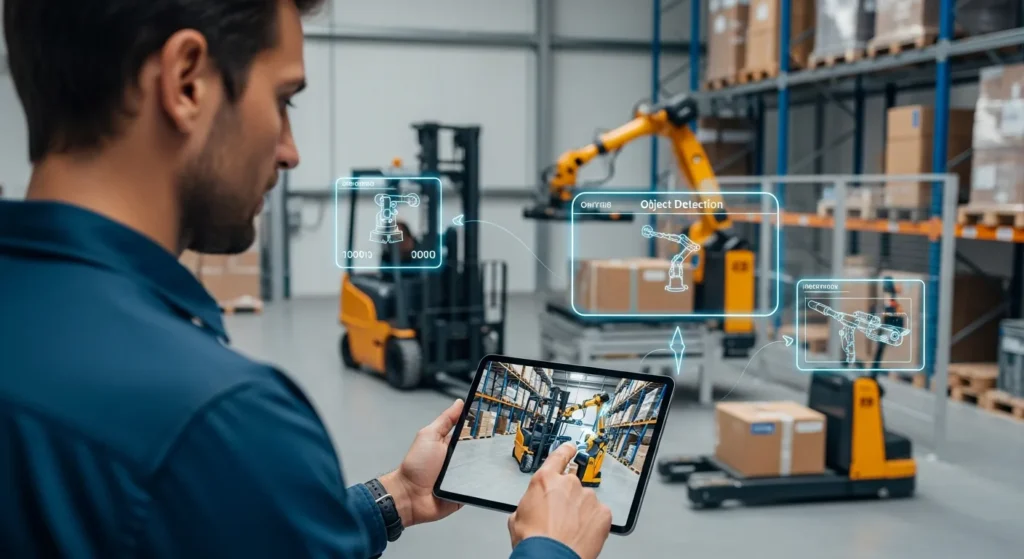
The Evolution of Visual Intelligence in 2026
In the current technological landscape of 2026, computer vision solutions have transitioned from experimental labs to the core of enterprise operations. These systems allow machines to interpret and understand the visual world, mimicking the human visual system but with the tireless precision of a digital processor. For a technical director, implementing these solutions means he can unlock insights from raw video data that were previously impossible to capture at scale.
Modern visual AI doesn’t just see; it understands context. Whether it is identifying microscopic defects on a high-speed assembly line or managing traffic flow in a smart city, the sophistication of these algorithms has reached a point where they can outperform human monitors in both speed and accuracy.
Key Applications of Computer Vision Solutions
The versatility of visual AI allows it to be deployed across diverse sectors. By leveraging deep learning and neural networks, businesses can automate complex tasks that once required constant human oversight. Here are the primary areas where these solutions are making an impact:
- Manufacturing and Quality Control: Automated optical inspection (AOI) systems detect structural flaws in real-time, ensuring that a project manager maintains his high standards for output without slowing down production.
- Retail Analytics: Heat mapping and shelf-monitoring allow retailers to understand customer behavior and optimize inventory levels automatically.
- Healthcare Diagnostics: AI-driven imaging helps a radiologist identify anomalies in X-rays and MRIs with higher sensitivity, allowing him to focus on critical patient care.
- Security and Surveillance: Advanced facial recognition and behavioral analysis provide proactive security measures for sensitive infrastructure.
When an executive begins his journey toward digital transformation, he often relies on an automation finder process discovery guide to identify the specific workflows where visual data can provide the highest return on investment.
The Infrastructure Behind Visual AI
Deploying robust computer vision solutions requires more than just a smart algorithm. It necessitates a synergy between high-performance hardware and scalable software architectures. In 2026, we see a shift toward Edge AI, where processing happens directly on the camera or a local gateway, reducing latency and bandwidth costs.
However, for large-scale deployments involving massive datasets, the backbone remains the cloud technology services enterprise landscape. This infrastructure provides the computational power needed to train complex models and the storage required for historical data analysis. A system architect must ensure his hardware choices—such as specialized GPUs and high-resolution CMOS sensors—align with his software’s throughput requirements.
Strategies for Successful Implementation
To successfully integrate computer vision into an existing business model, a leader must follow a structured approach. It is not merely a “plug-and-play” scenario; it requires careful data curation and iterative testing.
Defining the Objective
A developer must first define what success looks like for his specific use case. Is the goal to reduce human error by 20%, or is it to automate a process that was previously manual? Without a clear KPI, the project risks becoming an expensive experiment rather than a functional solution.
Data Quality and Annotation
The performance of any computer vision solution is directly tied to the quality of the training data. He must ensure that the dataset is diverse, well-labeled, and representative of real-world conditions. Synthetic data generation has become a popular tool in 2026 to fill gaps in rare edge cases that are difficult to capture naturally.
Frequently Asked Questions
What are the main components of a computer vision system?
A standard system consists of image acquisition hardware (cameras/sensors), a processing unit (CPU/GPU/TPU), and the software stack (algorithms and neural networks) that interprets the visual data.
How does computer vision differ from simple image processing?
While image processing focuses on transforming images (like sharpening or blurring), computer vision aims to extract high-level understanding and actionable insights from those images, such as identifying an object or predicting its movement.
Is real-time processing possible with computer vision solutions?
Yes, especially with the advancement of Edge AI and 5G connectivity. A network engineer can now deploy models that process video frames in milliseconds, allowing for immediate feedback in autonomous systems or safety monitoring.
What are the privacy considerations for visual AI?
Privacy is a critical concern. A responsible developer implements data anonymization techniques, such as face blurring and local processing, to ensure he complies with global data protection regulations while still gaining the benefits of visual analytics.