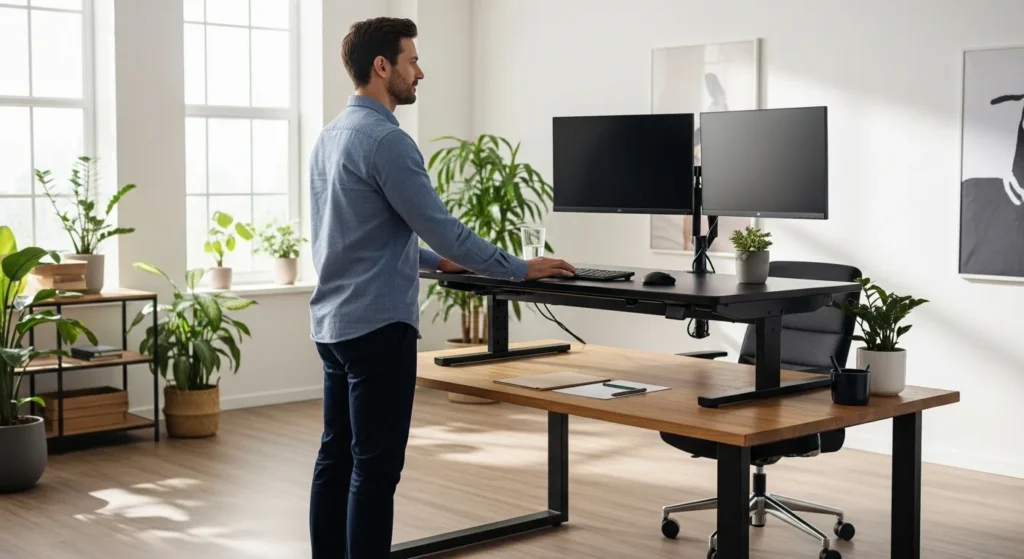
Understanding the Concept of a Riser Desk
In the evolving landscape of modern office environments, the riser desk—often referred to as a standing desk converter—has become a staple for the health-conscious professional. But what exactly is it? At its core, a riser desk is an adjustable platform that sits on top of an existing traditional desk. It allows the user to transition from a sitting to a standing position without needing to replace his entire furniture setup.
As we move through 2026, the focus on workplace ergonomics has intensified. A professional no longer has to choose between a standard desk and a full standing desk. Instead, he can utilize a riser to gain the flexibility he needs to remain active throughout his workday. This device typically features a two-tier design: a top surface for monitors and a lower tray for a keyboard and mouse.
How a Desk Riser Works
The mechanics of a riser desk are designed for ease of use. Most models employ one of two primary adjustment methods: manual or electric. Manual risers often use a gas-spring or hydraulic mechanism, allowing the user to lift the platform with minimal effort by squeezing a handle. He can then lock it into his preferred height.
Electric models, on the other hand, feature a motorized lift system. With the press of a button, the professional can watch his entire workstation rise to a standing height. This is particularly useful for those who have heavy equipment or simply prefer a hands-free transition. When a user is considering his setup, he might find that integrating a desk extender for laptop is a great first step, but a full riser offers a more robust solution for long-term ergonomic health.
Key Benefits for the Modern Professional
The primary appeal of the riser desk lies in its health benefits. Prolonged sitting has been linked to numerous physical issues, including back pain and poor circulation. By incorporating a riser, a professional can alternate his posture, which helps in reducing the strain on his lumbar spine and neck.
- Improved Posture: Standing encourages a more natural alignment of the spine compared to slouching in a chair.
- Increased Energy: Many users find that standing for portions of the day helps them maintain higher energy levels and better focus.
- Customizable Height: Unlike fixed desks, a riser allows a man to set his equipment exactly at eye level, preventing neck craning.
- Space Efficiency: It utilizes the vertical space on his existing desk, making it ideal for smaller home offices.
Optimizing Your Riser Desk Setup
To get the most out of a riser desk, the professional must ensure his peripherals are positioned correctly. His monitor should be at eye level to prevent strain, and his elbows should be at a 90-degree angle when typing. In 2026, many professionals are utilizing complex setups that require more than just a single screen.
For the power user, connecting multiple monitors to a laptop while using a riser can significantly enhance his workflow. He must ensure that the riser he chooses has a weight capacity sufficient for his dual or triple monitor arms. A sturdy base is essential to prevent wobbling while he is typing in a standing position.
Choosing the Right Model for Your Needs
When a professional begins his search for the perfect riser, he should consider the dimensions of his current desk. He needs to ensure the footprint of the riser fits comfortably without overhanging the edges. Additionally, he should look for a model that offers a wide range of height adjustments to accommodate his specific stature.
Material quality is also a factor. A high-grade steel frame with a scratch-resistant finish will ensure that his investment lasts for years. He should also look for integrated cable management features, which help him keep his workspace clean and organized, allowing him to focus entirely on his tasks.
Frequently Asked Questions
Is a riser desk as stable as a full standing desk?
While a full standing desk is generally the most stable option, high-quality risers are designed with heavy bases to minimize movement. A professional will find that as long as he does not exceed the weight limit, his equipment will remain secure.
Can I use a riser desk with a laptop?
Yes, many risers are specifically designed to hold laptops. He can place his laptop on the top tier and use an external keyboard on the lower tray for a more ergonomic experience.
How often should I switch between sitting and standing?
Most ergonomic experts suggest a 20:8:2 ratio: 20 minutes sitting, 8 minutes standing, and 2 minutes of moving or stretching. The professional should listen to his body and adjust his habits to find what works best for his comfort.
Do riser desks come fully assembled?
Many modern models come nearly fully assembled out of the box. Usually, the user only needs to attach the keyboard tray, allowing him to upgrade his workspace in just a few minutes.