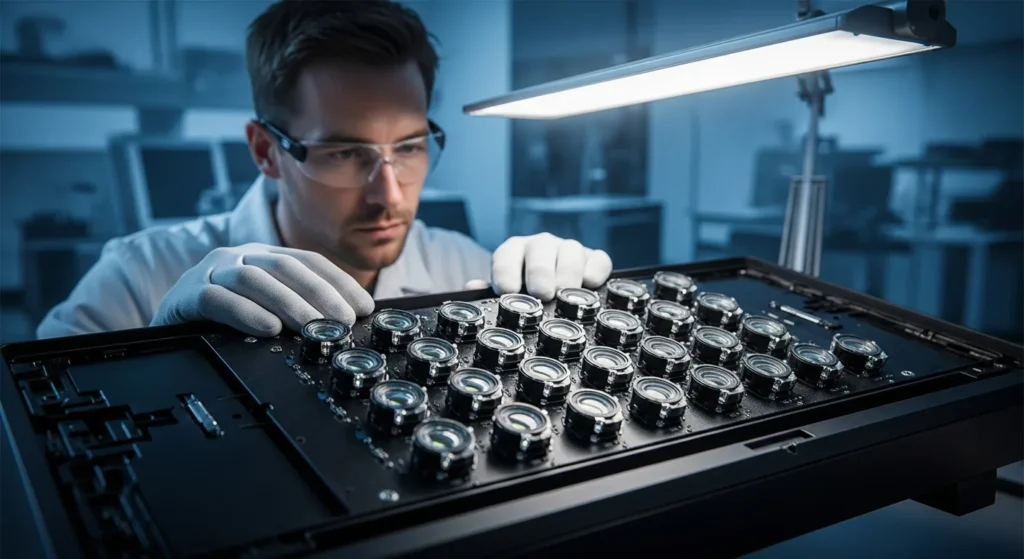
Understanding the Core of Display Optics
In the rapidly evolving world of display engineering, the back light unit lens technology patent landscape has become a primary battlefield for innovation. As we move through 2026, the demand for thinner, brighter, and more energy-efficient screens has pushed manufacturers to rethink the fundamental physics of how light is distributed behind a panel. A back light unit (BLU) is the engine of any liquid crystal display, and the lens sitting atop the LED is the steering wheel that directs every photon.
When an engineer files a patent for a new lens design, he is typically looking to solve the problem of light uniformity. Without a precisely engineered lens, a display would suffer from ‘hot spots’—areas where the LED is visibly brighter than the surrounding space. By securing a back light unit lens technology patent, a developer protects his unique method of refracting light at wider angles, allowing for fewer LEDs to be used while maintaining a perfectly even glow across the surface.
Key Innovations in Back Light Unit Lens Technology
The current year has seen a surge in filings related to Micro-Lens Arrays (MLA). These patents describe intricate patterns etched into the lens surface at a microscopic level. For the hardware specialist, this means he can now achieve higher luminance without increasing power consumption. This is particularly vital when deciding whether you should opt for a laptop with an LCD screen, as the efficiency of the BLU directly impacts battery life.
The Role of Refractive Index Optimization
Many recent patents focus on composite materials. An inventor might specify a multi-layer lens where each layer has a different refractive index. This allows him to ‘trap’ and redirect light that would otherwise be lost to internal reflection. By optimizing these paths, the back light unit lens technology patent ensures that the maximum amount of light reaches the viewer’s eyes, reducing the heat signature of the device.
The Shift Toward Mini-LED and Micro-Lens Integration
As displays transition toward Mini-LED architectures, the lenses have had to shrink significantly. A modern back light unit lens technology patent often covers the integration of the lens directly onto the LED chip packaging. This ‘Lens-on-Chip’ approach is a game-changer for mobile devices. When exploring how the touch-sensitive layers of modern laptops function, it becomes clear that every millimeter saved in the backlight layer allows for more robust sensors or larger batteries elsewhere in the chassis.
- Ultra-wide angle distribution: Patents now regularly feature lenses capable of spreading light at 160 degrees or more.
- Total Internal Reflection (TIR) Structures: These designs prevent light leakage, ensuring deep blacks in localized dimming zones.
- Heat-resistant polymers: New patents protect the chemical composition of lenses that do not yellow or warp under the intense heat of high-output LEDs.
Why Patent Protection is Crucial for Manufacturers
For a tech giant, his portfolio of patents is his most valuable asset. The back light unit lens technology patent prevents competitors from copying the specific curvature or material blend that gives his products a competitive edge in brightness or color accuracy. In the high-stakes world of consumer electronics, a single breakthrough in lens geometry can lead to a multi-year lead in the market, as he can produce thinner devices than his rivals without sacrificing visual quality.
Frequently Asked Questions
What is a back light unit lens technology patent?
It is a legal protection granted to an inventor for a specific design, material, or manufacturing process related to the lenses used in display backlighting. These lenses are responsible for diffusing and directing light from LEDs to ensure uniform screen brightness.
How do these patents affect the price of electronics?
While patent royalties can add to the cost, the innovations they protect often lead to more efficient manufacturing. For example, a patented lens that spreads light better allows a manufacturer to use fewer LEDs, which can eventually lower the total bill of materials for his device.
Are these lens patents relevant to OLED screens?
No, OLED screens are self-emissive, meaning each pixel produces its own light and does not require a back light unit. These patents are specifically for LCD and Mini-LED displays that rely on a separate light source behind the panel.
What is the most common material used in patented BLU lenses?
Most patents currently focus on high-grade optical polycarbonates or acrylics (PMMA), though newer filings are increasingly exploring silicone-based hybrids for better thermal stability and higher refractive indices.